After the Lanterns Go Dark: Kansai's Late-Night Food Scene That Locals Actually Eat In
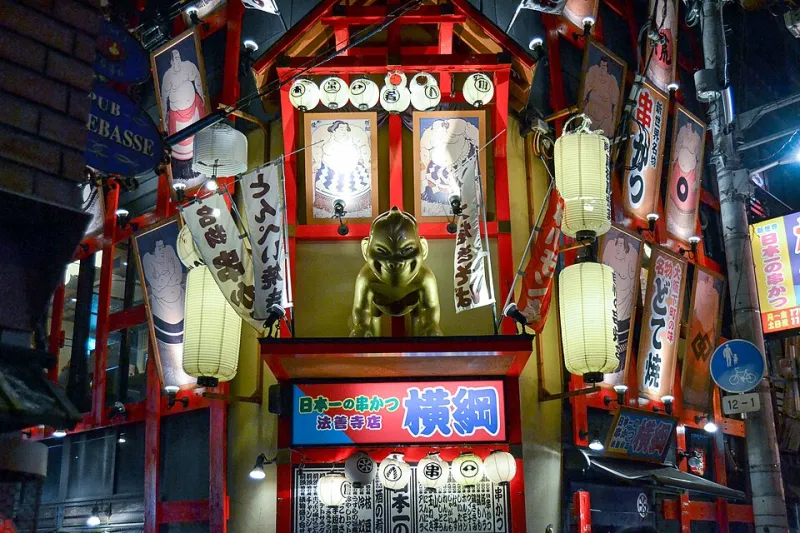
Photo: Andrew Braun, CC BY 3.0, via Wikimedia Commons
It's 11 p.m. on a Tuesday in Osaka. The Dotonbori selfie crowd has thinned. The conveyor belt sushi places are pulling their shutters. And roughly three blocks away, in a narrow alley that smells like charcoal smoke and miso, a line of office workers, taxi drivers, and one extremely tired chef are waiting for a table at a place with no website, no English menu, and no sign visible from the street.
This is the part of Kansai food culture that guidebooks mostly skip — not because it's secret, exactly, but because it operates on a schedule and a social logic that's hard to explain without just experiencing it. The region that gave the world takoyaki, kushikatsu, and kaiseki also has a vibrant, wonderfully chaotic nocturnal food ecosystem that most tourists never stumble into. Here's how to find it.
Why Kansai Eats Late
Osaka has a phrase — kuidaore — that roughly translates to "eat until you drop." It's not just a slogan. It reflects a genuine cultural orientation toward food as the point of a night out, not an afterthought to drinking. This means that Osaka in particular has developed an infrastructure of late-night eating that would make New York City feel like it closes early.
Kyoto operates a bit differently. The city's traditional culture creates an earlier, quieter evening rhythm in its tourist-facing neighborhoods. But the parts of Kyoto that locals actually live in — Fushimi, Nishioji, the streets around Toji — have their own late-night logic, built around izakayas and small yakitori joints that don't really get going until 9 or 10 p.m.
Kobe sits somewhere in between: a port city with a longer history of international influence, which means its late-night food scene has an eclectic, slightly unpredictable character that rewards wandering.
Osaka's Warehouse District Vendor Scene
The area around Kyobashi station — northeast of the city center, well off the tourist circuit — has quietly become one of Osaka's most interesting late-night food zones. The neighborhood has a gritty, post-industrial texture: old warehouses, wide streets, a lot of neon that's seen better days. And scattered through it are vendor collectives and informal food markets that run from around 9 p.m. to well past midnight.
These aren't Instagram-ready night markets. There are no fairy lights or artisan candle vendors. What you'll find instead is a rotating cast of food stalls — some permanent, some showing up only on weekends — selling things like negiyaki (a green onion-heavy pancake that's the less famous sibling of okonomiyaki), grilled chicken hearts, cold tofu with ginger and bonito, and sake served in what appear to be repurposed jam jars.
The social dynamic is worth noting for American visitors: these spots tend to be communal in a way that can feel unfamiliar. You may end up sharing a plastic table with strangers, and conversation — even across a language barrier — is generally welcomed. Pointing at what someone else is eating and raising your eyebrows is a completely acceptable ordering strategy.
Kyoto After Dark: The Backstreet Yakitori Circuit
Kyoto's most interesting late-night eating happens in the gaps between the famous things. The streets immediately surrounding Nishiki Market (closed by evening) give way to a network of izakayas and yakitori counters that come alive exactly when the market goes quiet. The Shinkyogoku arcade area, usually associated with tourist tchotchkes, has a handful of basement-level yakitori spots that are almost entirely local in clientele after 9 p.m.
Yakitori in Kyoto skews slightly different from the Osaka or Tokyo versions — there's a stronger influence of Kyoto-style seasoning, which tends toward salt and light citrus rather than heavy tare sauce. Chicken neck, cartilage, and liver are common on menus; if you're adventurous, ordering the nankotsu (cartilage) at a spot that's been grilling it for decades is a genuinely great experience.
The Fushimi district, known to tourists primarily for its sake breweries and the Fushimi Inari shrine, has a completely different character at night. The brewery district stays active late, and several spots near the Fushimi Momoyama station area serve as informal gathering points for local sake industry workers after their shifts. These are not places with English menus. They are, however, places where showing up politely and pointing at the sake menu on the wall will generally result in someone taking care of you.
How to Navigate Without a Map
The honest truth about Kansai's late-night food scene is that over-planning kills it. The best spots are the ones you find by following your nose, literally — charcoal smoke, fermented soy, frying oil. These are your navigation tools.
A few practical guidelines:
Look for the salaryman clusters. In Japan, office workers who eat out late are reliable food quality indicators. They're eating on expense accounts or after long shifts, and they have strong opinions about where the food is actually good. A counter full of men in loosened ties at 10:30 p.m. is almost always a positive sign.
Basement and second-floor spots are frequently better than street level. Tourist-facing restaurants pay for street visibility. The places that don't need to advertise are often up a narrow staircase or down a half-flight of steps. A hand-lettered sign and a noren (fabric divider) over the entrance is your green flag.
Don't be intimidated by no-English menus. Point at what looks good. Say kore (this one) and hold up fingers for quantity. Most late-night spots in Kansai have dealt with enough curious visitors to handle this gracefully.
Kobe's Kitano and Sannomiya areas deserve a mention for American visitors specifically. Kobe's long history as an international port means the late-night food scene here has absorbed influences from multiple directions — there's a Chinatown (Nankinmachi) that runs later than you'd expect, and the streets around Sannomiya station have an eclectic mix of izakayas, Korean barbecue, and small ramen counters that stay open past 1 a.m.
What Veteran Vendors Want You to Know
Talking to long-running vendors in Osaka's informal market circuit, a few themes come up consistently. One yakitori operator who's been working the same Kyobashi spot for over 20 years put it simply: "The tourists come for the famous things. The locals come for the food." It's not meant as an insult — it's an observation about how food culture works when it's not performing for an audience.
Another vendor, who runs a negiyaki cart in the Tsuruhashi area (Osaka's Korea Town, which has its own distinct late-night food identity), noted that the rhythm of her night changes completely around 10 p.m. Before that, she gets a mix of curious visitors and early-dining locals. After that, it's almost entirely people who know exactly what they want and have been coming back for years. "That's when it gets real," she said.
The Tsuruhashi area is worth a specific mention: it's one of the few places in Kansai where Korean-Japanese food culture has been layering for generations, producing a street food style that's genuinely distinct from anything you'll find in Seoul or Tokyo. Late-night Korean barbecue in Tsuruhashi, eaten at a table that's basically in the alley, with cold beer and pickled vegetables appearing without being ordered — that's a Kansai experience that most visitors never find.
The Best Time to Show Up
If you want to experience Kansai's nocturnal food culture at its most alive, aim for the window between 9:30 p.m. and midnight on weeknights. Weekend nights get louder and more crowded; weeknights have a more relaxed, regular-customer energy that makes it easier to fall into conversation and get recommendations for what to try next.
Come hungry. Come curious. Leave the itinerary at the hotel. The best meal you'll have in Kansai after dark is probably one you stumbled into.