Why Getting Confused at Osaka Station Might Be the Best Thing That Happens to You
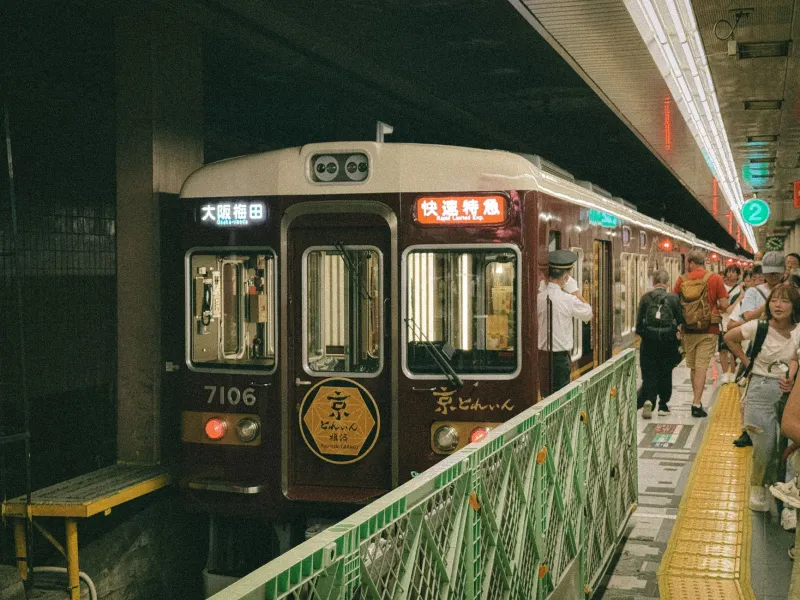
You've done your research. You've got your IC card loaded, your Google Maps queued up, and your exit number memorized. Then you step off the train at Osaka Station, and within thirty seconds, you're standing in the middle of an underground corridor that branches four ways, surrounded by signs in kanji, and you have absolutely no idea which direction is north.
Welcome to Kansai. The confusion is part of the lesson.
Most first-time visitors treat the region's big transit hubs like obstacles — something to survive before the real trip begins. But spend enough time in Osaka, Kyoto, or Kobe, and you start to realize something: the locals aren't navigating these stations with GPS. They're reading them. And once you learn to do the same, you don't just get better at catching trains. You get better at the whole trip.
The Station as a City Within a City
Osaka Station — technically the Osaka Umeda complex when you fold in the Hankyu, Hanshin, and subway lines nearby — is legitimately one of the most complicated transit environments in the world. It's not just a place you pass through. There are department stores, restaurants, underground shopping arcades, rooftop gardens, and pedestrian bridges that connect to buildings you didn't even know were part of the complex. Think of it less like Penn Station and more like a small neighborhood that happens to have trains running through it.
Kyoto Station is its own kind of architectural spectacle — a massive glass-and-steel structure that opened in 1997 and still feels futuristic against the city's traditional backdrop. It has a rooftop sky garden, a theater, a hotel, a shopping mall, and a dizzying network of escalators and sky bridges that locals use as shortcuts most tourists never discover.
Kobe's Sannomiya area works differently again — more spread out, with the Hankyu, Hanshin, JR, and subway lines all operating within a few blocks of each other but not always connected underground. Getting between them requires a little street-level intuition.
None of this is accidental. These stations evolved organically over decades, shaped by competing rail companies, urban development pressures, and the sheer volume of daily commuters who needed efficient paths between platforms. The result is dense, layered, and genuinely hard to read at first — but it rewards attention.
Stop Looking at Your Phone and Look at the Signs
Here's the thing about navigating Kansai stations the way locals do: it's almost entirely visual. Not visual in the way that Google Maps is visual, but environmental — reading the space itself.
Japanese station signage is actually extremely well-designed once you understand the system. Exit numbers (出口, deguchi) are consistent and correspond to specific streets and landmarks above ground. Color-coded lines are labeled in both Japanese and romaji. Platform numbers are prominently displayed. The challenge isn't that the information isn't there — it's that there's so much of it that first-timers tend to freeze or default to their phones.
Local commuters barely glance at their phones inside the station. They've internalized the spatial logic of their route, and they use peripheral awareness to track landmarks — a particular kiosk, a staircase angle, the sound of a specific platform announcement. You can start building that same awareness faster than you think, if you're willing to put the phone away for a few minutes and just observe.
Try this: the next time you're inside a big Kansai station, stop walking for sixty seconds and just watch. Notice which direction the crowd is flowing. Notice where the rush is coming from and where it's going. In most cases, the human current will point you toward the exits, the main platforms, or the transfer gates more reliably than any map.
The Accidental Discoveries Hidden in the Maze
Here's what nobody tells you about getting turned around in a Kansai station: some of the best eating, shopping, and people-watching in the entire region is tucked inside these complexes.
The underground shopping arcade beneath Osaka's Umeda area — a network called Whity Umeda and Diamor Osaka — stretches for blocks beneath the city and is packed with ramen counters, izakayas, coffee shops, and boutiques that cater almost entirely to local commuters. Most tourists walk right past the entrance because it doesn't look like a tourist attraction. It isn't. That's exactly why you should go.
Kyoto Station's basement level has a ramen street (Kyoto Ramen Koji) and a food hall that stocks regional specialties from across the Kansai area. The rooftop garden on the tenth floor is free to access and offers a view of the city that most visitors never find because they assume it's off-limits.
In Kobe, the covered shopping street that runs from Sannomiya toward Motomachi is accessed through what looks like a random station exit but opens into one of the most vibrant local retail corridors in the region. If you're following a map, you might miss it entirely. If you're wandering with some awareness of your surroundings, you'll stumble into it naturally.
The Skill That Transfers Everywhere
There's a reason locals who grew up in Osaka or Kyoto tend to be extremely good at navigating cities they've never visited before. The spatial reasoning you develop by learning to read a complex transit hub — tracking exits, predicting crowd flow, using visual landmarks instead of GPS — is genuinely transferable.
Once you've cracked the logic of Osaka Station, somewhere like Tokyo's Shinjuku Station (which has over 200 exits and is technically the busiest station in the world) starts to feel approachable rather than terrifying. Once you've learned to read Kansai station signage by sight, you'll find yourself picking up wayfinding cues in other Japanese cities almost automatically.
But more than the practical skill, there's something that shifts in your relationship to the trip itself. When you stop treating transit as an obstacle and start treating it as part of the experience, you arrive at your destinations differently — less frazzled, more present, and with a handful of unexpected discoveries you never would have found if you'd followed the fastest route.
A Few Practical Starting Points
If you want to start building this skill deliberately rather than accidentally, here are a few low-stakes ways to practice:
- Use the station before you need to. If you're staying near Osaka Station, spend twenty minutes just walking the concourse without a destination. Learn where the exits are relative to each other before you're rushing to catch a train.
- Pick an exit at random. Seriously. Take any exit you haven't used before and see what's above ground. You'll build a mental map of the station's relationship to the city faster than any app can give you.
- Count the platforms. Every time you transfer, take a second to note which platform you arrived on and which direction you're heading. This sounds small, but it builds directional intuition quickly.
- Eat one meal inside the station. Not at a convenience store — find a sit-down spot in the underground food hall or on one of the upper floors. You'll start to see the station as a place, not just a passageway.
Kansai's train stations aren't trying to confuse you. They're just built for people who live here. The good news is that with a little patience and a willingness to look up from your phone, you can start to feel like one of them — and that changes everything about the way you move through this part of Japan.