Stone, Water, and Silence: Learning to Read Kansai's Temple Gardens Like a Designer
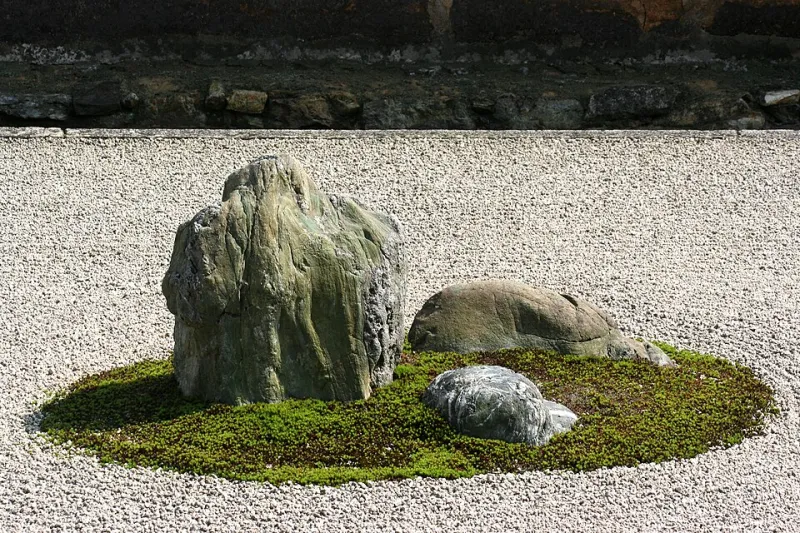
Photo: Tedmoseby, CC BY-SA 3.0, via Wikimedia Commons
There's a moment that happens in almost every Kansai temple garden, usually somewhere between the second and third rock formation. You stop. You look. You feel like you're supposed to feel something — and you're not entirely sure what it is. Most people take a photo and keep walking. But that pause? That's actually the whole point.
Japanese garden design isn't decorative. It's argumentative. Every stone placement, every moss-covered bank, every carefully redirected trickle of water is making a claim about the nature of the universe — and your job, if you're willing to take it on, is to figure out what that claim is. Once you know what to look for, a 45-minute garden stroll becomes something closer to reading a novel.
The Garden as a Map of the Mind
Most of Kansai's great temple gardens — Ryoanji, Daisen-in, Saihoji, the stroll garden at Shinjuan — were designed during or after the Muromachi period (roughly 1336 to 1573), when Zen Buddhism was deeply intertwined with Japanese aesthetics. The gardens weren't built for picnics. They were built for monks to sit with, think through, and eventually dissolve into.
This context matters because it reframes what you're looking at. A Western garden — think Central Park or the National Mall — tends to be about abundance and welcome. A Zen-influenced karesansui (dry landscape garden) is about reduction. Designers stripped away everything that wasn't load-bearing. What's left is intentional to a degree that can feel almost aggressive once you tune into it.
When you enter a garden like Ryoanji's famous rock garden in northwest Kyoto, resist the urge to immediately find the "best angle." Instead, sit down — there are wooden viewing platforms for a reason — and ask yourself: what is this space refusing to show me? The 15 stones are arranged so that no matter where you sit, exactly one stone is hidden. That's not an accident. It's a statement about perception, incompleteness, and the limits of any single viewpoint. Welcome to the puzzle.
How to Read a Stone
In Japanese garden design, stones are never just rocks. They carry symbolic weight drawn from Chinese landscape painting traditions, Shinto animism, and Buddhist cosmology — all layered together in ways that took centuries to develop.
A few things to look for:
Vertical stones typically represent yang energy — active, upward, masculine in the classical Chinese sense. Horizontal stones suggest yin — receptive, grounded, still. When you see them paired, you're watching a conversation about balance. At Daisen-in in Daitokuji temple complex, a vertical stone formation near the garden's "mountain" section is meant to evoke Mount Horai, the mythical island of immortality from Chinese legend. The stone isn't trying to look like a mountain. It's trying to be the idea of a mountain.
Also pay attention to placement relative to other stones. Groupings of three, five, and seven appear constantly in Japanese garden design — odd numbers are considered more dynamic, more alive. A cluster of five stones isn't just five stones. It's a rhythm.
Water That Isn't There
Dry garden design — raked gravel standing in for water — is one of the most misunderstood elements for first-time visitors. The gravel isn't a placeholder for a water feature that the temple couldn't afford. The absence of actual water is the point.
In karesansui design, the raked patterns in gravel represent ocean waves, river currents, or the flow of time itself — depending on the garden and the tradition behind it. The abstraction requires your participation. You have to do the imaginative work of animating the stillness. That active engagement is a deliberate part of the experience.
At Ryoanji, the gravel is raked in concentric ovals around each stone grouping, suggesting water flowing around islands. At other gardens, you'll see straight parallel lines suggesting a calm sea, or diagonal cuts suggesting a current in motion. When you enter a dry garden space, ask yourself: where is the water moving? Which direction is the current going? What's the mood — still lake or rushing river? The answer will tell you something about what the designer wanted you to feel.
The Seasonal Layer
Kansai's temple gardens were also designed as calendars. Moss gardens like Saihoji (popularly called Kokedera, the Moss Temple) in Kyoto's Nishikyo ward look completely different in June's rainy season versus October's dry cool. That's not a bug — it's a feature baked in at the design level.
Many gardens include specific plantings that mark the year's turning points: plum trees that bloom in late January and February, cherry trees for spring, maples that go nuclear red in November, and bare branch patterns that frame winter snow. When you visit matters. A maple garden in July is a green wall. In November it's a fire. Designers like the legendary Kobori Enshu — responsible for several Kyoto gardens — thought in terms of how a space would perform across all four seasons, not just at peak bloom.
If you can only visit once, late March through April and mid-November are the moments when most gardens are performing at something close to their designed peak. But don't discount an off-season visit. A garden in January, half-empty of tourists and stripped of its foliage, shows you its bones — and that's often where the real design thinking lives.
Moving Through a Stroll Garden
Not all Kansai temple gardens are meant to be viewed from one fixed point. The kaiyushiki, or stroll garden style, was designed to be experienced in motion — which creates a completely different set of design challenges and opportunities.
In a stroll garden, the designer controls what you see by controlling where you walk and what's hidden around each bend. This is called miegakure — "hide and reveal" — and it's one of the central techniques of Japanese garden design. A well-executed stroll garden will make a relatively small space feel enormous by constantly surprising you with new vistas, then closing them off again.
At Shinjuan, a sub-temple within Daitokuji, the path through the garden is almost theatrical in how it stages views. You'll round a corner and suddenly the entire garden opens up. Take three more steps and a hedge blocks half of it. This isn't careless landscaping — it's choreography. Walk slowly. Stop often. Turn around occasionally, because designers frequently set up views that are meant to be seen on the return pass.
The Permission to Slow Down
Here's the practical takeaway: budget more time than you think you need, and give yourself permission to look confused. The gardens that reward the most attention are often the ones that seem simplest on first glance — a flat rectangle of gravel and 15 rocks, a single pond with three stepping stones, a moss hillside with no flowers at all.
Bring a notebook if you're the type. Sketch the stone groupings. Note what's directly in your sightline when you sit at the main viewing point. Ask yourself what the designer is hiding and why. Kansai's temple gardens were built for exactly this kind of slow, argumentative attention — and they've been waiting a long time for someone to show up and argue back.