Wrong Turn, Right Experience: What Kansai's Confusing Streets Are Actually Teaching You
You've been staring at your phone for four minutes. The blue dot says you're exactly where you need to be, but you're standing in front of a shuttered umbrella repair shop and a vending machine selling hot corn soup. The temple is supposedly thirty meters away. There is no temple visible from any angle.
Welcome to Kansai. Pull up a curb.
This is the moment most tourists reach for frustration. But here's what the savvier ones — the ones who come back year after year — have figured out: that four-minute standoff with your GPS is actually the best thing scheduled on your itinerary today. You just don't know it yet.
Why Kansai Was Never Designed to Be Easy to Navigate
American cities have a logic that most of us absorb without thinking. Numbered streets, named avenues, grids that make rough sense even in an unfamiliar neighborhood. Even cities with messy layouts — Boston, New Orleans, San Francisco's hills — follow some internal logic you can puzzle out within a day or two.
Kansai doesn't work like that, and it never really did.
Kyoto has a grid, technically, but it's a grid interrupted by centuries of temple compounds, aristocratic estates, and river channels that bent the geometry into something far more interesting than the original plan. Osaka evolved as a merchant city, and merchant cities grow organically — along waterways, around warehouses, through whatever gaps commerce could squeeze into. Nara sprawls according to the logic of deer paths and ancient pilgrimage routes. Nobody sat down with graph paper.
The result is a region where street names are inconsistently posted (or not posted at all), where addresses refer to districts and sub-districts rather than numbered locations, and where a single block can contain three different neighborhood identities. It's genuinely disorienting, even for Japanese visitors from Tokyo. And that disorientation is, counterintuitively, the whole point.
The Psychology of Getting Turned Around
Researchers who study spatial cognition have noted something interesting: when we navigate with GPS, we're essentially passengers in our own journey. The app does the cognitive work, and our brains coast. We arrive at destinations with almost no memory of how we got there.
But when navigation gets hard — when we have to actually look — our brains shift into a different gear. We start reading environmental cues. We notice which direction the shadows fall. We register the smell of incense drifting from a side gate. We observe that the stone lanterns have gotten more elaborate over the last hundred meters, which probably means something significant is nearby. We become, in a very literal neurological sense, more present.
Travelers who've spent time genuinely lost in Kansai describe a similar phenomenon. Sarah, a landscape architect from Portland who visited Kyoto for the first time two years ago, put it this way: "I'd been following my phone all morning and seeing nothing. Then it died. Within twenty minutes of wandering without it, I found a textile workshop I never would have looked for, had a broken-language conversation with the owner's mother, and bought the best souvenir of my trip. The dead battery was the best thing that happened to me all week."
That's not a coincidence. It's what happens when you stop consuming a place and start actually inhabiting it.
What the Streets Are Asking You to Notice
Kansai's neighborhoods are layered in ways that reward attention. The width of a street tells you something about its age and original purpose. A lane barely wide enough for two bicycles might be older than the United States. The material underfoot shifts — packed earth giving way to stone, stone giving way to tile — and each transition marks a different era of the city's life.
Temple walls and garden boundaries create micro-climates you can feel before you see them. The air gets cooler. Sound dampens. You start to sense a compound before it's visible, the way you'd sense a park in a dense urban neighborhood before the trees come into view.
Shops and workshops cluster in ways that still reflect old guild districts. In certain parts of Kyoto's Nishijin neighborhood, you can hear the mechanical percussion of looms through the walls of buildings that look, from the outside, like ordinary houses. You'd walk past them at a purposeful GPS-guided pace without registering the sound at all.
Getting disoriented slows you down enough to catch all of this. And catching it is the difference between having visited Kansai and having actually been there.
When Locals Become Your Navigation System
Here's the other thing that happens when you're lost in Kansai: you have to talk to people.
For many American travelers, this is the terrifying part. Japan has a reputation — not entirely undeserved — for being a country where strangers don't necessarily invite interaction. But asking for directions in Kansai operates by different social rules than you might expect.
Kansai people, and Osakans in particular, have a regional reputation within Japan for being warm, direct, and genuinely interested in outsiders. If you approach someone with a map or a phone and an apologetic expression, the response is far more likely to be enthusiastic helpfulness than polite deflection. People will walk you to the corner. They'll draw maps on their hands. They'll call over a friend who speaks more English.
These are the interactions that become stories. Not "I saw the famous temple" stories, but "I got hopelessly lost near the covered market and a retired schoolteacher walked me six blocks out of her way to make sure I found the shrine" stories. The ones you tell at dinner for years.
Getting lost creates the conditions for those encounters. A perfectly optimized itinerary, executed without friction, almost never does.
How to Get Lost on Purpose (Without Actually Panicking)
None of this means you should throw your phone in the Kamo River and wander blind. There's a practical middle ground that gets you the perceptual benefits of disorientation without the genuine stress of being truly stranded.
Leave the hotel without a specific destination for the first hour of your morning. Pick a general direction — toward the hills, toward the river, toward wherever the foot traffic seems to thin out — and walk. Notice what you notice. Follow whatever pulls your attention.
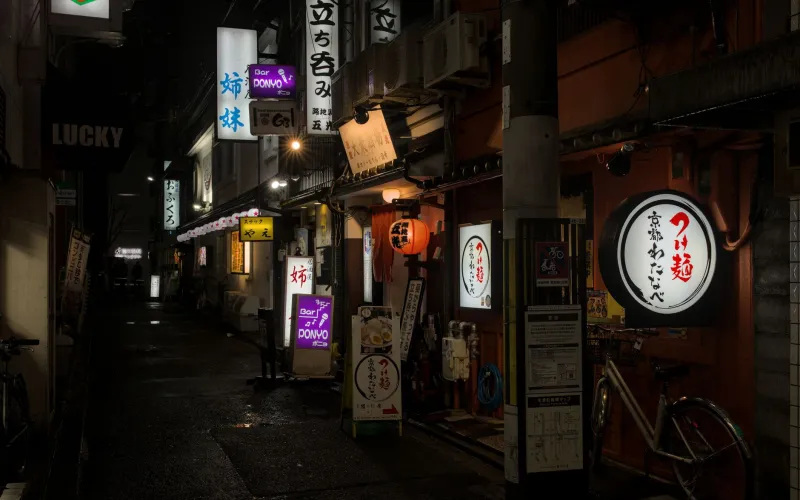
Give yourself permission to enter any alley that looks interesting. Kansai's side streets almost always lead somewhere worth finding, even if that somewhere is just a beautiful dead-end garden wall or an unexpectedly perfect vending machine placement.
Save the GPS for when you genuinely need to catch a train. Use it as a rescue device, not a leash.
And when you do get turned around — when the map stops making sense and you're standing in front of that umbrella repair shop with no temple in sight — resist the instinct to immediately fix it. Stand there for sixty seconds. Look around like you actually want to understand where you are. Something will catch your eye. It usually does.
The Souvenir You Didn't Know You Were Collecting
Kansai gives you two kinds of memories. The official ones — the golden pavilion, the deer park, the neon of Dotonbori — are real and worth having. But the unofficial ones, the ones born from confusion and wrong turns and unexpected conversations, tend to be the ones that stick.
The region's navigational chaos isn't a bug in the travel experience. It's an architecture for a different kind of attention, one that turns you from a tourist into something closer to a witness. And witnesses, it turns out, remember a lot more than visitors do.
So go ahead. Get lost. Kansai's been waiting for you to arrive.