One Thing, Done Forever: What Kansai's Master Craftspeople Know About Work That Silicon Valley Never Will
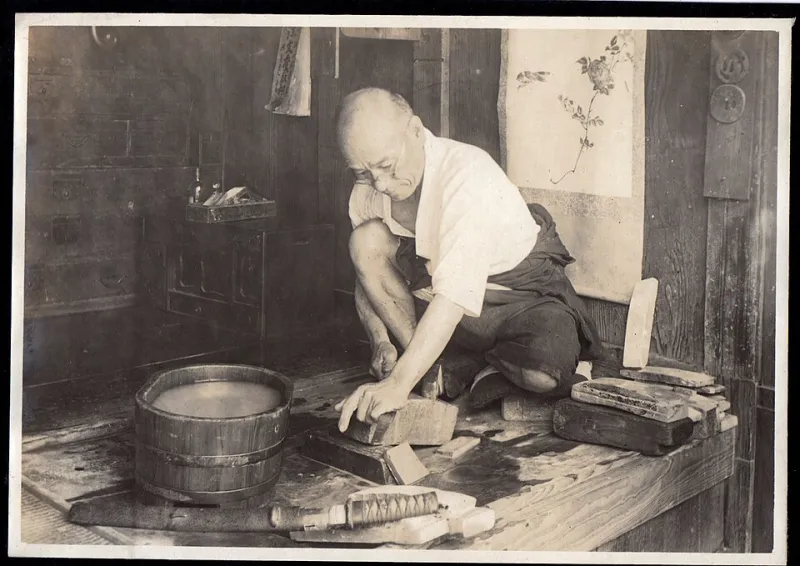
Photo: Elstner Hilton, CC BY 2.0, via Wikimedia Commons
Somewhere in a narrow Kyoto side street, a man in his late sixties is dyeing fabric. He has been dyeing fabric since he was nineteen. He does not have a side hustle. He does not have a five-year growth plan. He is not pivoting. He is dyeing fabric, and he is extraordinarily good at it, and when you watch him work, something strange happens: you start to feel embarrassed about your LinkedIn profile.
This is a pretty common experience for American visitors who wander off the main tourist drag in Kansai. You find a workshop. You peer inside. Someone is doing something with total, unhurried concentration — folding paper, throwing clay, hammering a blade — and the whole scene radiates a kind of calm that feels almost confrontational. Like the work itself is quietly judging you.
It's not a performance. It's not a tourist trap dressed up as authenticity. It's just what mastery looks like when it's been stripped of every incentive to be anything other than itself.
The Word You Need to Know: Shokunin
Japanese has a word for this kind of person: shokunin. It translates roughly as "craftsperson" or "artisan," but that doesn't really capture it. A shokunin isn't just someone who makes things with their hands. It's someone who has organized their entire life around the pursuit of a single skill — not to get famous, not to build a brand, but because the work itself demands it.
Chef and food writer Nobu Yamazaki once described the shokunin mindset this way: the goal isn't to be the best in the world. The goal is to be better tomorrow than you were today. That's it. Indefinitely. There's no finish line, no exit strategy, no Series B funding round.
For Americans raised on the gospel of hustle — where standing still means falling behind and every skill is a potential revenue stream — this is genuinely disorienting. It's supposed to be.
Inside the Workshops
Kyoto's Nishijin district is probably the most concentrated place in Japan to watch this philosophy in action. This is where the city's famous woven textiles come from — intricate silk fabrics that have been produced in essentially the same way for over a thousand years. The workshops here aren't museums. They're working operations, often run by families who have been doing this specific thing for four or five generations.
Visiting one of the smaller studios — not the polished showrooms near the main tourist areas, but the actual workspaces tucked behind unmarked doors — you'll often find weavers who produce maybe two or three finished pieces a month. At those quantities, you're not getting rich. That's not the point. The point is that each piece is as close to perfect as the maker can get it right now, which is closer than they could get it last year.
In Sakai, just south of Osaka, you'll find a similar ethos among the city's legendary knife makers. Sakai has been producing blades since the sixteenth century, and the craftspeople here are not interested in your suggestions about automation or online retail strategy. A master knife maker might finish eight to ten blades in a week, each one hand-finished to a standard that takes decades to develop. When a Sakai knife maker says a blade is ready, it's ready. Not "good enough for the price point." Ready.
Osaka's Nakanoshima district has its own quiet version of this in the ceramic studios scattered through its older neighborhoods. Potters here often work in styles tied to specific regional traditions — Shigaraki ware, Iga ware — that impose their own constraints. You're not free to make whatever the market wants. You're working within a form, deepening your relationship with it, finding the infinite variation inside the finite.
What Deliberate Limitation Actually Looks Like
Here's the thing that catches most American visitors off guard: these artisans aren't struggling. They're not noble sufferers clinging to a dying trade out of stubbornness. Many of them have waiting lists. Some have turned down partnerships with major retailers. A few have been approached by investors and politely declined.
They limit output deliberately — not because they can't produce more, but because producing more would change what they're making. Volume and mastery don't scale together. Every shokunin knows this. It's not a trade-off they agonize over. It's just the nature of the work.
Compare that to the default American framework, where success is defined by growth almost by definition. A small business that stays small is considered to have failed, or at least stalled. A skill that doesn't generate multiple income streams is considered underutilized. The idea that you might deliberately cap your output — not because you're lazy or unambitious, but because expansion would compromise the thing you're actually trying to do — reads as almost countercultural in the US context. In Kansai's workshops, it's just Tuesday.
The Productivity Myth Nobody Told You About
There's a version of this story that turns into a simple "slow down and smell the roses" travel essay, and that's not really what's happening here. The shokunin aren't relaxed in some spa-day sense. Watch a master dyer work and you'll see intense focus, physical precision, and a level of exacting self-criticism that would make most productivity gurus faint. These people work hard. They just work hard at one thing.
What they've rejected isn't effort. It's the idea that effort should be constantly redirected toward whatever generates the most output, the most revenue, the most growth. They've rejected the notion that doing one thing well is somehow leaving potential on the table.
For American travelers — especially the ones who take their laptops on vacation, who answer Slack messages in line at Fushimi Inari, who describe themselves as "passionate about multiple verticals" — spending even an hour watching a shokunin work can feel like a minor existential event. Not because it's relaxing. Because it's clarifying.
How to Actually Find These Workshops
You're not going to stumble into most of these places. The ones that cater to tourists are fine, but they're not quite the same thing. What you want are the working studios, and those require a little navigation.
In Kyoto, the Nishijin Textile Center is a decent starting point, but walk the surrounding streets afterward — that's where the real workshops are. In Sakai, a short train ride from Osaka on the Nankai Line, the tourist office near the station can point you toward knife makers who accept visitors by appointment. Osaka's Minami Horie neighborhood has a cluster of craft studios that are genuinely working spaces, not showrooms.
The rule of thumb: if there's a sign in English out front designed to attract you, it's probably not what you're looking for. If you have to ask someone where it is, you're getting warmer.
What You Might Actually Take Home
The souvenirs are great — a Sakai knife or a Nishijin silk piece is a legitimate object of beauty that will outlast anything you bought at the airport. But the more durable thing you can take home from these encounters is harder to pack.
It's the simple, slightly uncomfortable question that tends to follow you out of these workshops and back onto the train: What's the one thing I'm actually trying to get good at?
Not optimize. Not monetize. Not leverage into adjacent opportunities. Just get genuinely, quietly, irreversibly good at.
Kansai's craftspeople have been sitting with that question for their entire working lives. Most of them seem pretty okay with the answer they found.